Lake Constance and the Rhine: Europe’s 536 km² Alpine Lake Shared by 3 Countries
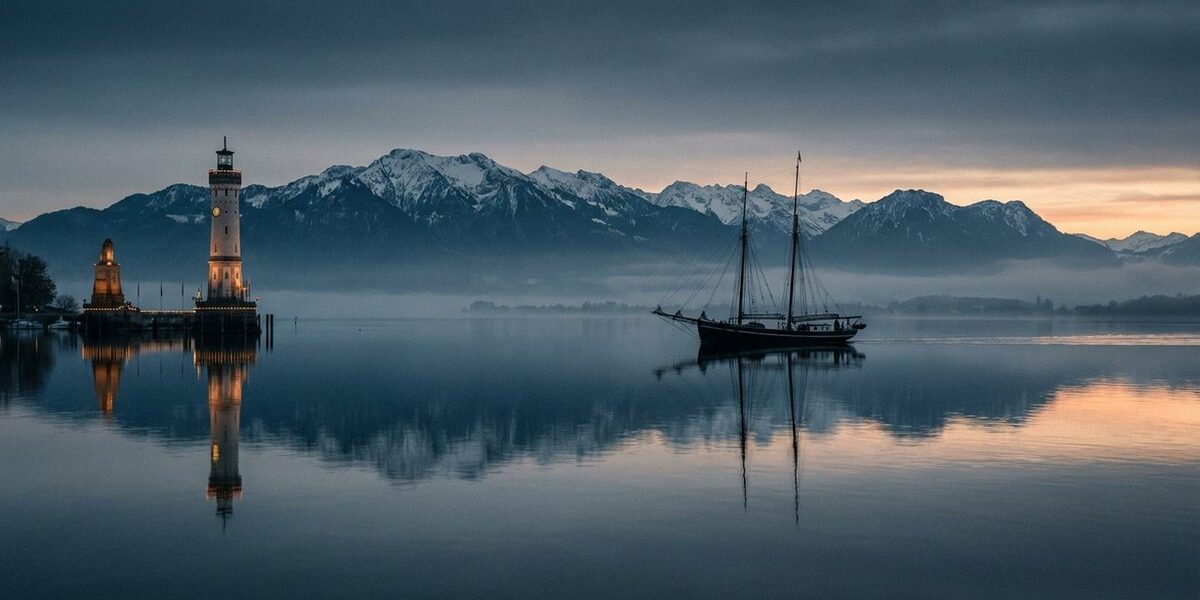
If you could stand on the eastern shore of Lake Constance and watch the Alpine Rhine pour in, you would see water thick with glacial sediment — gray-green and turbulent. Walk to the western end at Stein am Rhein, and the water leaving the lake is strikingly different: clearer, bluer, calmer. What happens in between is one of the most important natural processes along the Rhine’s entire 1,232.7 km course. Lake Constance does not merely interrupt the Rhine — it transforms it.
Geography and Dimensions
Lake Constance (Bodensee in German) sits at the northern edge of the Alps at 395 meters above sea level, straddling the borders of Germany, Austria and Switzerland. It consists of two basins:
- Obersee (Upper Lake): The main basin, 473 km², up to 254 meters deep — the deepest point in the lake.
- Untersee (Lower Lake): The smaller western basin, 63 km², connected to the Obersee by the 4-km Seerhein channel through the city of Konstanz.
Key figures: 536 km² total surface area · 254 m maximum depth · 48.5 km³ water volume · 63 km long · up to 14 km wide · 3 countries (Source: IGKB — Internationale Gewässerschutzkommission für den Bodensee)
By surface area, Lake Constance is the third-largest lake in Central Europe (after Lake Balaton and Lake Geneva). By water volume — 48.5 cubic kilometers — it ranks as one of the most significant freshwater reserves in Western Europe. That volume is roughly equivalent to the Rhine’s total annual discharge at Basel.
The Rhine Enters and Exits
The Alpine Rhine enters Lake Constance from the southeast near Bregenz, Austria. It arrives carrying a heavy sediment load — fine rock particles ground by Alpine glaciers and washed down by tributaries. This sediment is clearly visible as a plume spreading into the turquoise-green lake water.
The lake acts as a massive natural sediment trap. As flow velocity drops to near zero in the still lake water, suspended particles settle to the lake floor. Over centuries, this process has built up a delta at the Rhine’s entry point that extends several hundred meters into the lake. Geologists estimate that the Alpine Rhine deposits approximately 2–3 million cubic meters of sediment into Lake Constance each year.
At the lake’s western end, the Rhine exits through the narrow channel at Stein am Rhein. The water that leaves is fundamentally different from what entered: stripped of sediment, temperature-moderated by the lake’s thermal mass, and with flood peaks smoothed by the enormous storage volume.
Hydrological Buffer
Lake Constance functions as a natural hydrological buffer — a term describing a feature that absorbs extremes in water flow. When Alpine snowmelt drives Rhine discharge to seasonal highs in late spring and early summer, the lake absorbs much of the surge before passing it downstream. When winter flows drop, the stored water maintains a more stable outflow than the Alpine Rhine alone could sustain.
This buffering effect matters for everything downstream. Without Lake Constance, the High Rhine below the lake would experience far more extreme fluctuations in discharge, making hydroelectric power generation less predictable and navigation less reliable. The lake does not eliminate floods entirely — extreme events can still propagate through — but it significantly reduces their frequency and intensity.
Drinking Water for 4 Million People
Lake Constance is one of Europe’s most important drinking water reservoirs. The Bodensee-Wasserversorgung (Lake Constance Water Supply), headquartered in Stuttgart, extracts water from the lake near Sipplingen at a depth of 60 meters and pipes it up to 180 km inland. This system supplies drinking water to approximately 4 million people in 320 cities and municipalities across Baden-Württemberg (Source: Bodensee-Wasserversorgung).
Water quality in Lake Constance has improved dramatically since the 1970s, when phosphorus concentrations peaked due to untreated sewage and agricultural runoff. Massive investment in wastewater treatment — coordinated through the IGKB (International Commission for the Protection of Lake Constance) — reduced phosphorus levels from over 80 µg/L in the 1970s to around 6 µg/L today. The lake is now classified as oligotrophic — low in nutrients and high in water clarity — which is its natural state.
Three Countries, One Lake
Lake Constance is shared by Germany (the largest shoreline), Austria (eastern shore) and Switzerland (southern shore). Unusually, there is no formal agreement on the exact course of the international borders within the Obersee — Germany maintains that the entire lake is a condominium (shared sovereignty), while Switzerland and Austria have argued for a median-line division. In practice, this ambiguity causes few problems: the IGKB, established in 1959, coordinates environmental protection, and local agreements handle fishing rights and navigation.
Major cities around the lake include Konstanz (Germany, ~85,000 inhabitants), Friedrichshafen (Germany, ~60,000), Bregenz (Austria, ~30,000) and Kreuzlingen (Switzerland, ~23,000). Tourism is a significant economic factor: the lake attracts millions of visitors annually for sailing, cycling along the 260-km shoreline path and visiting attractions like the island of Mainau and the prehistoric stilt-house settlements recognized as UNESCO World Heritage Sites.
Climate Change and the Lake’s Future
Lake Constance is not immune to the changes reshaping the Rhine basin. Water temperatures have risen measurably over recent decades, affecting the lake’s thermal stratification — the layering of warm and cold water that controls nutrient cycling and oxygen distribution. Warmer winters reduce the frequency of full lake mixing (Holomixis), which is essential for replenishing deep-water oxygen levels.
As Alpine glaciers retreat — projections suggest significant loss by mid-century — the sediment and water supply to Lake Constance will change. Summer inflows may decrease by up to 25% under high-emission scenarios (Source: ICPR Technical Report 297, 2024). For the 4 million people downstream who depend on lake water, and for the Rhine system that relies on the lake’s buffering function, these shifts will require careful adaptation.
Lake Constance is far more than a scenic stop on the Rhine’s journey. It is a water treatment plant, a flood buffer, a drinking water reservoir and a transboundary commons — all shaped by natural forces and sustained by international cooperation. For the Rhine’s full story, explore the geography hub and the seven river sections that define its course.