Rhine Romanticism: How Turner, Byron & Heine Turned the Middle Rhine into Europe’s Most Celebrated Landscape
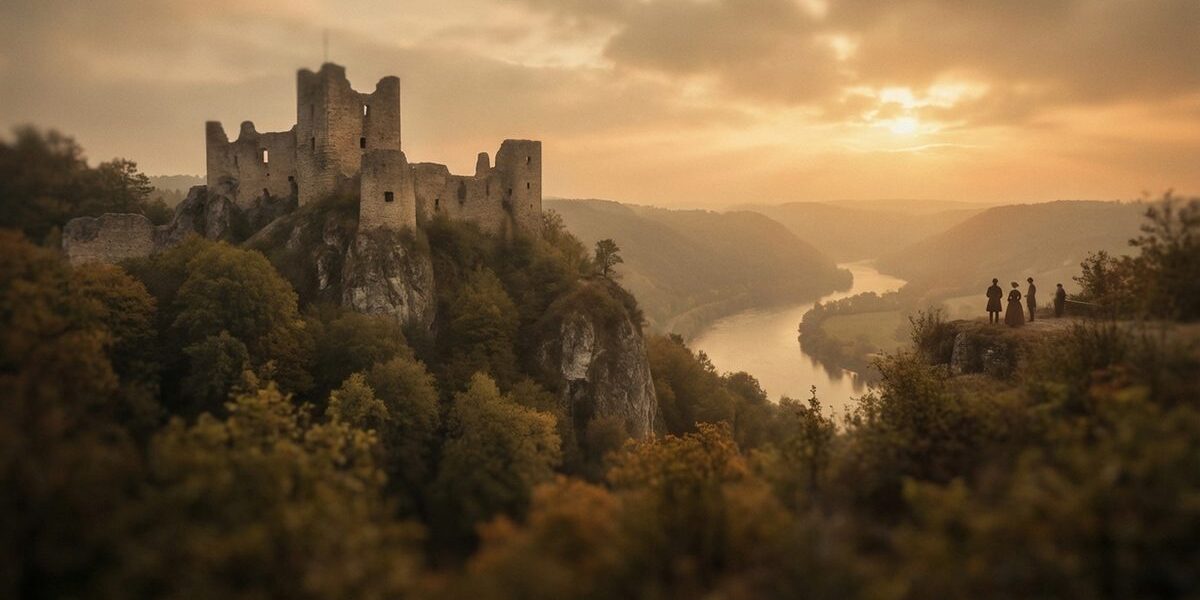
In the summer of 1817, the English painter J.M.W. Turner boarded a boat on the Rhine and began sketching. Over the following weeks, he filled more than 90 pages with watercolors and pencil studies of the river gorge between Cologne and Mainz. He would return to the Rhine repeatedly over the next 27 years, producing some of the most luminous river landscapes in the history of Western art.
Turner was not alone. In the early decades of the 19th century, a remarkable convergence of artists, poets, and travellers descended on the Middle Rhine. What they found — and what they created — became known as Rhine Romanticism (Rheinromantik), a cultural movement that transformed a working river into a symbol of beauty, nostalgia, and national identity.
The Setting: Why the Rhine, Why Then?
Several forces converged to make the Rhine the focus of Romantic attention. The Napoleonic Wars (1803–1815) had closed much of continental Europe to British travellers. When peace returned, a generation of artists and writers poured across the Channel, hungry for scenery that matched the emotional intensity of Romantic aesthetics. The Rhine gorge, with its crumbling castles, steep vineyards, and mist-filled valleys, delivered exactly that.
There was also a technological factor. Steamship service on the Rhine began in 1827, making the journey between Cologne and Mainz faster, cheaper, and more comfortable than ever before. The first Rhine steamship company, the Preußisch-Rheinische Dampfschiffahrtsgesellschaft, was founded in 1825. Within a decade, tens of thousands of passengers were making the trip annually. The Rhine became, in the words of travel historians, Europe’s first tourist destination — a landscape consumed not for commerce or pilgrimage, but for aesthetic pleasure.
The Painters: Turner, Schinkel, and the Rhine on Canvas
J.M.W. Turner (1775–1851) made at least five journeys to the Rhine. His watercolors of the Loreley, Bacharach, Ehrenbreitstein, and the Drachenfels are among the finest depictions of the river landscape ever produced. Turner was drawn to light and atmosphere — the way morning mist dissolved a castle into its hillside, the way sunset turned the river gold. His Rhine works are held in the Tate Britain in London and remain reference points for how the Romantic eye saw the river.
Karl Friedrich Schinkel (1781–1841), the great Prussian architect, painted Rhine landscapes in his early career before turning to architecture. His theatrical, stage-set-like compositions of Gothic cathedrals and moonlit ruins helped define the visual language of Rhine Romanticism. Schinkel later put his vision into stone, designing the Neo-Gothic reconstruction of Schloss Stolzenfels near Koblenz (1836–1842), which became one of the most visible monuments of the movement.
Other painters followed: Caspar Scheuren, whose Rhine panoramas were published as popular prints; Andreas Achenbach, who painted dramatic Rhine storms; and dozens of lesser-known artists whose works filled the drawing rooms and galleries of London, Paris, and Berlin.
The painters did not simply document what they saw. They selected, heightened, and idealized. Ruins were made more dramatic, skies more turbulent, figures more picturesque. The Rhine of the Romantic painters is recognizably the real river, but filtered through an aesthetic that valued emotion over accuracy. This selective vision shaped expectations: tourists who arrived after seeing Turner’s watercolors expected to find exactly the sublimity he had painted — and often did, because they had been taught how to look.
The Poets: Byron, Heine, and Hugo
The literary response to the Rhine was equally powerful. Lord Byron (1788–1824) sailed up the Rhine in 1816 and devoted multiple stanzas of Childe Harold’s Pilgrimage to the river. His description of the Drachenfels — “The castled crag of Drachenfels / Frowns o’er the wide and winding Rhine” — became one of the most quoted passages of English Romantic poetry. Byron’s endorsement carried enormous cultural weight; where he went, fashionable society followed.
Heinrich Heine (1797–1856) contributed the other side of Rhine Romanticism: the German perspective. His 1824 Loreley poem became the single most famous literary work associated with the river. But Heine’s relationship with Rhine Romanticism was ambivalent. His later writings mocked the movement’s sentimentality, even as his own poem had done more than almost any other text to create it.
Victor Hugo (1802–1885) published Le Rhin in 1842, a detailed travelogue of his Rhine journey. Hugo’s account mixed landscape description with political reflection — he saw the Rhine as a potential bridge between France and Germany rather than a dividing line. His book was widely read and introduced the Rhine landscape to French readers who might otherwise never have encountered it.
The Legacy: From Movement to Tourist Industry
Rhine Romanticism did more than produce great art and literature. It fundamentally changed how people related to the landscape. Before the Romantic era, the Middle Rhine gorge was a working corridor — a place of toll castles, fishing villages, and barge traffic. After it, the gorge was also a destination, a place to be experienced for its beauty and its atmosphere.
The UNESCO World Heritage designation of 2002 is, in a sense, the institutional recognition of what the Romantic movement initiated two centuries earlier. The criteria for inscription — that the valley represents an outstanding example of a cultural landscape shaped by human interaction with the natural environment — echo the Romantic vision of the Rhine as a place where nature and culture are inseparable.
The movement also created a visual vocabulary that persists. Tourism brochures, wine labels, and even the logos of Rhine shipping companies still draw on imagery — castles, vineyards, misty gorges — that was codified by Turner, Schinkel, and their contemporaries in the 1820s and 1830s.
The UNESCO World Heritage designation of the Upper Middle Rhine Valley in 2002 can be read as an institutional confirmation of what the Romantics sensed two centuries ago: that this stretch of river represents something more than the sum of its castles and vineyards. It is a landscape where nature and human culture have shaped each other for so long that the two are inseparable.
Rhine Romanticism is not just a historical episode. It is the lens through which the world still sees the river. I have walked the Rheinsteig trail above Bacharach and recognized the same compositions — the same interplay of ruin, vine, and water — that Turner painted two hundred years ago. The river has changed, the castles have been restored, and the sailing boats are now container barges. But the view from the ridgeline is still, unmistakably, the Rhine the Romantics fell in love with.