The Loreley Rock on the Rhine: The Legend, the 132-Metre Cliff & Germany’s Most Famous River Landmark
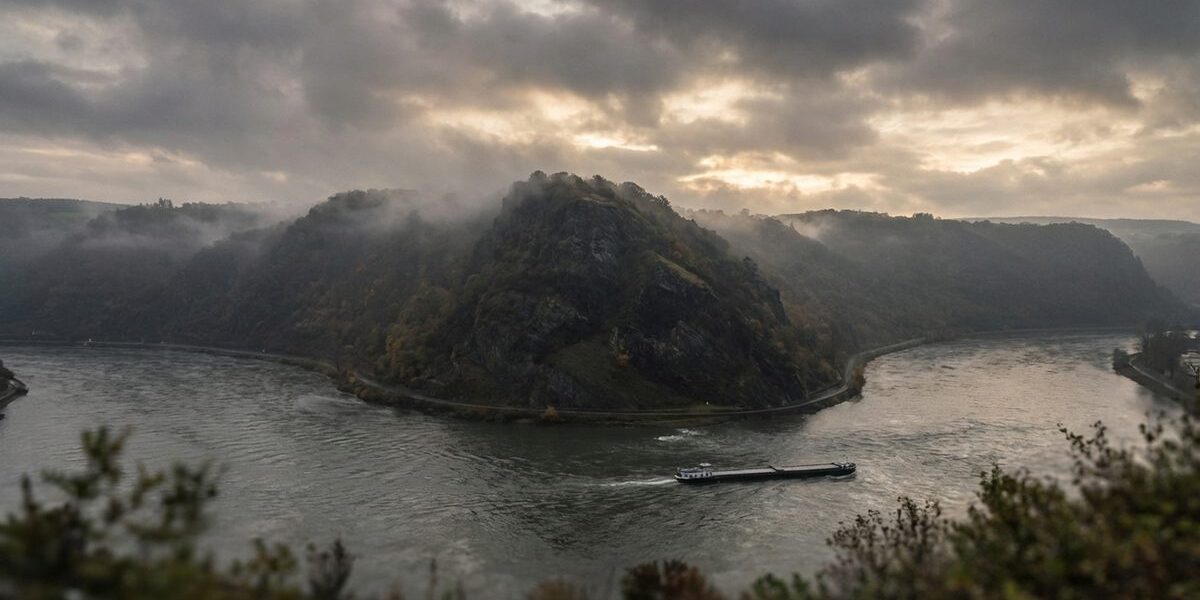
At Rhine kilometre 555, the river bends sharply and narrows to just 113 metres — the tightest point on the navigable Rhine. On the right bank, a massive cliff of Devonian slate rises 132 metres above the waterline. Below it, the current accelerates and the riverbed drops to 25 metres in depth (Source: WSV). For centuries, this combination of narrow passage, fast water, and submerged rocks made the Loreley one of the most dangerous stretches for Rhine shipping.
Today, the Loreley is Germany’s most famous river landmark — and the subject of a legend that is both younger and more deliberately constructed than most people realize.
The Geology: Why the Rhine Narrows Here
The Loreley is not a single dramatic outcrop by accident. It marks a point where particularly hard quartzite and slate formations resist the erosion that has widened the Rhine gorge elsewhere. The Rhenish Slate Mountains (Rheinisches Schiefergebirge) through which the Middle Rhine cuts are roughly 400 million years old, formed during the Devonian period when this region lay beneath a shallow tropical sea.
As the Rhine carved its gorge over the past two million years, softer rock was worn away while the Loreley’s harder formations held firm. The result is a natural bottleneck: the riverbed narrows, the water depth increases, and currents become unpredictable. Seven submerged rocks once lurked beneath the surface near the cliff’s base, creating eddies and cross-currents that could swing a wooden barge sideways in seconds.
Before modern channel markings and echo-sounding equipment, navigating this stretch was genuinely hazardous. Ships ran aground regularly, and the strong echo bouncing off the cliff face — which amplified every sound, including the rush of water — added to the sense of danger. The name “Loreley” itself likely derives from the old German lureln (to murmur) and ley (rock) — the murmuring rock. It was a place that demanded explanation, and for centuries, the explanation was simply that the rock was cursed.
The Invention of a Legend: Brentano and Heine
Unlike most river legends, the Loreley story has a precise origin. In 1801, the German Romantic poet Clemens Brentano published his ballad Zu Bacharach am Rheine in his novel Godwi. In it, he invented a figure named Lore Lay — a beautiful woman whose heartbreak gives her a fatal, almost supernatural allure. Brentano set his story at Bacharach, not at the Loreley rock itself, and his Lore Lay was a mortal woman, not a water spirit.
Over the following two decades, other writers picked up and reshaped the story. The poet Niklas Vogt associated the figure with the cliff itself. But it was Heinrich Heine who made the legend immortal. His 1824 poem Die Lore-Ley opens with one of the most recognized lines in German literature:
Ich weiß nicht, was soll es bedeuten,
Dass ich so traurig bin;
Ein Märchen aus alten Zeiten,
Das kommt mir nicht aus dem Sinn.— Heinrich Heine, 1824
Heine’s version placed a golden-haired maiden on top of the rock, combing her hair and singing a melody so captivating that boatmen below forgot to steer and were dashed against the rocks. It is this image — the siren on the cliff — that entered the global imagination. Heine’s poem has been translated into more than 40 languages and set to music by Friedrich Silcher in 1837, creating the melody most Germans can hum from memory.
A “Fairy Tale from Ancient Times” — That Isn’t Ancient at All
Heine’s own poem contains a knowing irony. He calls the Loreley story “ein Märchen aus alten Zeiten” — a fairy tale from ancient times — even though it was barely twenty years old when he wrote those words. Whether Heine was being playful or deliberately mythologizing a modern invention is still debated by literary scholars. What is certain is that the poem worked: within a generation, the Loreley was treated as an authentic folk legend, its literary origins largely forgotten by the general public.
During the Nazi period, Heine’s Jewish heritage created an awkward problem. The poem was too famous to suppress, so it was included in anthologies with the attribution “Dichter unbekannt” — author unknown. This attempt to erase Heine from his own creation only added another layer to the legend’s complicated history.
The Loreley Today
The Loreley rock sits at the heart of the UNESCO Upper Middle Rhine Valley World Heritage Site. A visitor center at the top of the cliff, redesigned and reopened in 2019, offers exhibitions on the geology, ecology, and cultural history of the site. An open-air amphitheater on the plateau hosts concerts and events during the summer months, with capacity for roughly 12,000 spectators.
Below the rock, the Rhine remains a busy commercial waterway. Modern navigation aids have eliminated most of the danger that once made this stretch notorious, but the narrow passage still demands full attention from ship captains. Roughly 200,000 vessels pass through the Middle Rhine gorge each year (Source: WSV), and the Loreley bend remains one of the points where traffic management is most critical. The rock is also one of the highlights on Rhine river cruises, drawing passengers to the deck as ships navigate the narrow bend.
I have stood on the Loreley plateau in November, when the tourists are gone and the mist sits low over the river. From up there, the Rhine looks deceptively calm. You can see why Brentano and Heine needed a supernatural explanation for the dangers below — the beauty of the place makes the hazard invisible.
The Loreley is a reminder that legends do not need to be ancient to be powerful. A poet’s invention from 1801, refined by a masterful lyricist in 1824, has become inseparable from the rock itself. The story has outlasted the dangers that inspired it, and the golden-haired figure on the cliff has become a symbol not just of the Rhine, but of the human impulse to find meaning — and narrative — in landscape.