9 Countries Share the Rhine: How Europe’s Most International River Connects a Continent
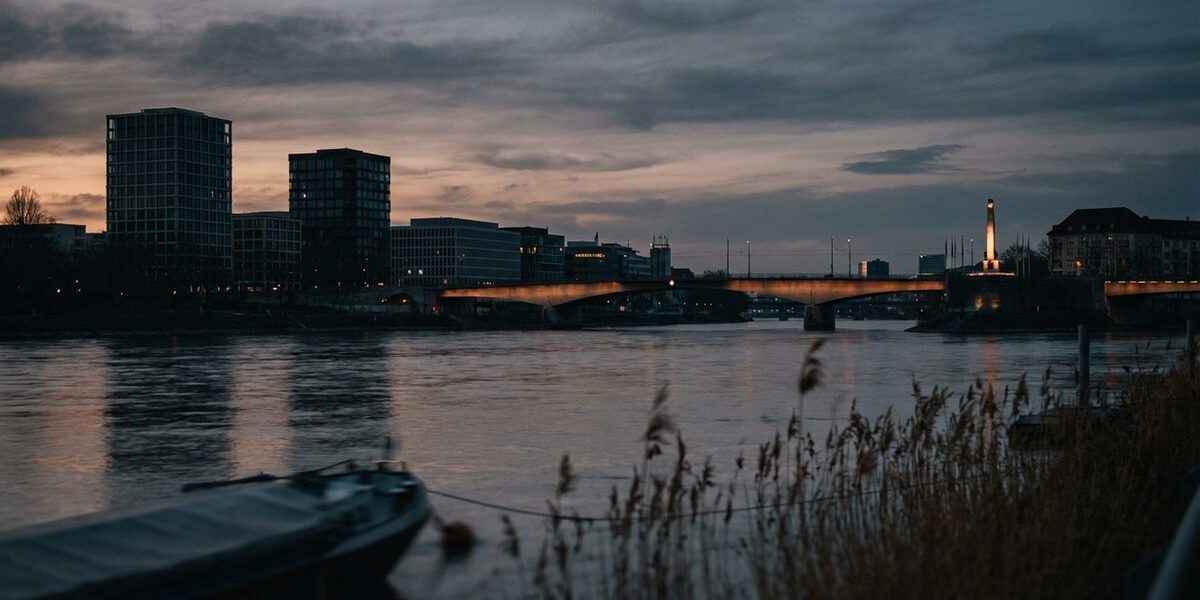
Rivers do not respect national borders, and the Rhine is the clearest proof. Nine countries — Switzerland, Liechtenstein, Austria, Germany, France, Luxembourg, Belgium, the Netherlands and Italy — share its 185,000 km² catchment area (Source: ICPR, 2024). What happens in a Swiss Alpine meadow affects drinking water quality in Amsterdam. A chemical spill near Strasbourg can shut down water intakes in Düsseldorf within days. This interconnection has forced the Rhine nations into one of the world’s most successful frameworks for international river management.
Who Shares What: Catchment Breakdown
| Country | Catchment Area (km²) | Share (%) | Rhine Border/Flow Length | Role in the System |
|---|---|---|---|---|
| Germany | ~105,000 | ~57% | 695.5 km (865.5 km incl. border sections) | Dominant riparian state; longest stretch, most cities, heaviest shipping |
| Switzerland | ~26,800 | ~14% | 376 km | Source country; Alpine headwaters, Aare tributary, Lake Constance |
| France | ~24,000 | ~13% | Border along Upper Rhine | Alsatian plain, Ill tributary, Grand Canal d’Alsace hydropower |
| Netherlands | ~24,000 | ~13% | 161.2 km | Delta country; Rotterdam seaport, drinking water, flood management |
| Luxembourg | ~2,400 | ~1.3% | No direct Rhine frontage | Moselle/Sauer tributary catchment |
| Austria | ~2,366 | ~1.3% | ~55 km (border along Alpine Rhine) | Vorarlberg, Lake Constance eastern shore |
| Belgium | ~800 | ~0.4% | No direct Rhine frontage | Hautes Fagnes drains into Moselle system |
| Liechtenstein | ~160 | ~0.09% | ~27 km (border along Alpine Rhine) | Flood protection partnership with CH and AT |
| Italy | ~51 | ~0.03% | No direct Rhine frontage | Val di Lei near Swiss border |
Sources: ICPR, 2024; CHR, 2015. Exact figures vary depending on whether the classic catchment (185,000 km²) or the EU Water Framework Directive IFGE (~200,000 km²) is used.
Germany: The Dominant Partner
With roughly 57% of the catchment and 695.5 km of river channel within its borders, Germany is by far the Rhine’s largest stakeholder. Six federal states (Bundesländer) border the Rhine: Baden-Württemberg, Rhineland-Palatinate, Hesse, North Rhine-Westphalia, Saarland and Lower Saxony. The river passes through or near some of Germany’s largest cities — Cologne (1.1 million), Düsseldorf (620,000), and the Ruhr metropolitan area (5.1 million).
Germany also generates the lion’s share of Rhine shipping traffic. The Lower Rhine between Cologne and the Dutch border sees approximately 200,000 vessel movements per year (Source: WSV/BDB). Duisburg, the world’s largest inland port, moves 50.8 million tonnes of cargo annually (Source: Duisport, 2024).
Switzerland: The Water Tower
Switzerland contributes only 14% of the catchment area but a disproportionate share of the water. The Aare tributary alone discharges 560 m³/s — more than the Rhine carries at their confluence. Swiss glaciers and snow reserves serve as natural reservoirs that sustain downstream flows during summer dry spells. As climate change accelerates glacier retreat, this water tower function is projected to diminish significantly by mid-century, with summer flows potentially declining by up to 25% (Source: ICPR Technical Report 297, 2024).
The Netherlands: Living With the Delta
The Netherlands receives all 2,210 m³/s of Rhine water at Lobith and must distribute it safely through its delta — a landscape largely below sea level. Dutch water management is among the most sophisticated on earth, with infrastructure like the Maeslantkering storm surge barrier (one of the world’s largest moving structures) and the Pannerdense Kop distribution point, which has maintained its fixed flow ratios since 1707.
Rotterdam, at the delta’s western end, is Europe’s largest seaport with 435.8 million tonnes throughput in 2024, generating an estimated 45.6 billion euros in economic value — 6.2% of the Netherlands’ GDP (Source: Port of Rotterdam, 2025). Dutch drinking water companies depend heavily on Rhine water filtered through dune infiltration systems, which makes upstream water quality a direct Dutch national interest.
Governance: The ICPR Model
The International Commission for the Protection of the Rhine (ICPR, German: IKSR) was established in 1950 and now includes all nine catchment states plus the European Union. It coordinates flood risk management, water quality monitoring, ecological restoration and climate adaptation across the entire basin.
The ICPR’s track record is one of the great environmental success stories. After the Sandoz chemical disaster of 1986 — when 20–30 tonnes of toxic agrochemicals entered the Rhine at Basel — the commission spearheaded investments of over 80 billion euros in wastewater treatment. Today, 96% of the catchment population is connected to municipal sewage treatment (Source: ICPR; AquaPedia). The Rhine’s current “Rhine 2040” program targets 200 km² of restored floodplains, 100 reconnected oxbow lakes, and a 30% reduction in micropollutants (Source: ICPR, 2024).
Alongside the ICPR, two other international bodies govern the Rhine:
- CCNR (Central Commission for Navigation on the Rhine): Established in 1815 at the Congress of Vienna, it is the world’s oldest international organization. The CCNR ensures free navigation between Basel and Rotterdam without tolls or fees.
- CHR (Commission for the Hydrology of the Rhine): Coordinates hydrological research, measurements and climate projections across the basin.
Upstream, Downstream: The Politics of Shared Water
Sharing a river always creates tension between upstream and downstream interests. Switzerland and Germany generate hydroelectric power and release thermal discharges from industry; the Netherlands must cope with the resulting water quality. When German industrial drought in 2018 caused economic losses of 0.4% of monthly GDP (Source: IfW Kiel), it was partly the Swiss glaciers — contributing up to 30% of low-flow discharge in extreme droughts — that kept the river from running even lower (Source: CHR, 2023).
PFAS contamination illustrates the challenge. In 2024, Dutch drinking water companies publicly called on Germany to reduce PFAS discharges into the Rhine after studies showed that concentrations of 23 PFAS compounds exceeded Dutch drinking water guideline values by a factor of 3–4 (Source: RIWA-Rijn, 2023). Such cross-border issues can only be resolved through the institutional framework that the ICPR provides.
The Rhine’s nine-country model is not perfect, but it works better than most. In a world where transboundary water conflicts are increasing, the Rhine demonstrates that shared governance — built over decades, tested by crises and backed by real investment — can turn a river from a source of conflict into a bond between nations. Learn more about the river’s full geography and its complete course from source to sea.
Sources & References
- ICPR: Nine Countries Share the Rhine
- CHR: Rhine Catchment Data
- Rhesi Project: Alpine Rhine — Swiss-Austrian Flood Protection