Rhine Cargo Transport: How 285 Million Tonnes Per Year Move Between Rotterdam and Basel
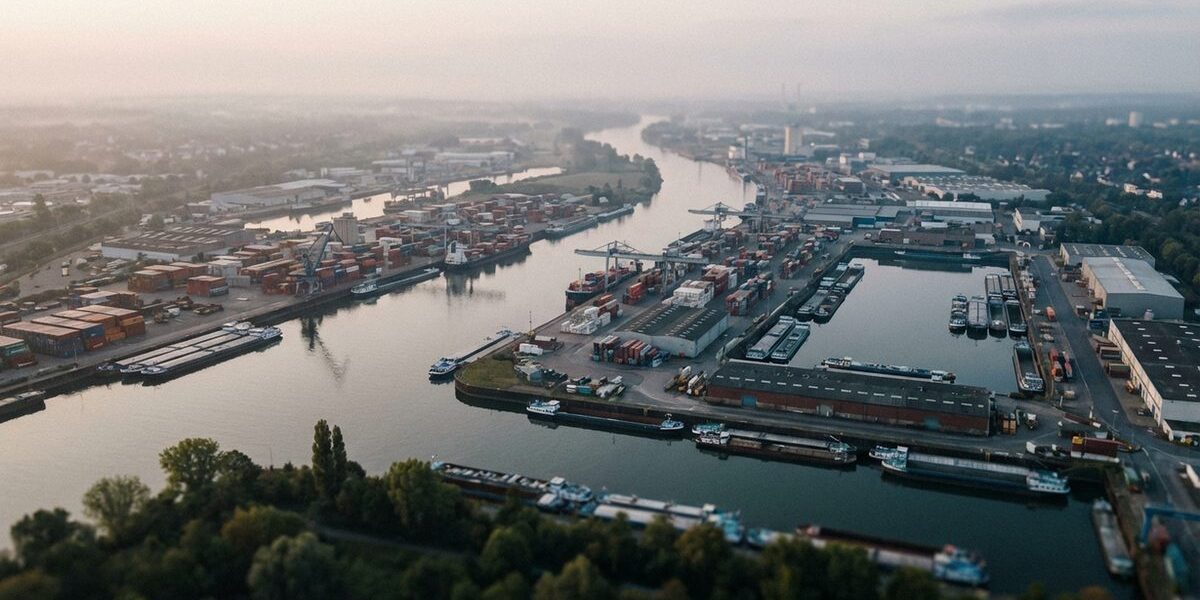
When people think of European freight transport, they picture motorways clogged with trucks or intermodal trains stretching across the landscape. Few realise that a single river — the Rhine — quietly moves approximately 285 million tonnes of cargo per year, accounting for roughly two-thirds of all inland waterway freight in the European Union (Source: CCNR, 2024). To put that in perspective: Germany’s entire rail freight network transported approximately 360 million tonnes in 2023. The Rhine alone approaches that figure, using a fraction of the energy and infrastructure.
Cargo Types: What Fills the Barges
The Rhine’s cargo mix reflects the industrial backbone of Western Europe. The river serves as a supply chain for steel mills, chemical plants, power stations, refineries, construction sites, and consumer goods distribution centres. Here is how the annual volume breaks down by commodity group:
| Commodity Group | Approx. Volume (million tonnes) | Share of Total | Key Products |
|---|---|---|---|
| Dry bulk | ~128 | ~45% | Iron ore, coal, building materials, grain, ores |
| Liquid bulk | ~86 | ~30% | Petroleum products, chemicals, LPG, vegetable oils |
| Containers (TEU-equivalent) | ~43 | ~15% | Consumer goods, electronics, machinery, mixed freight |
| Other (break bulk, heavy lift, RoRo) | ~28 | ~10% | Project cargo, vehicles, steel coils, machinery |
(Source: CCNR Market Observation Report, 2024; Eurostat, 2024)
Dry Bulk: The Heavyweight Category
Dry bulk has been the Rhine’s dominant cargo category for over a century. Iron ore shipped upstream from Rotterdam to the steelworks of the Ruhr and Saar regions remains one of the river’s signature flows, even as European steel production has declined from its peak. A single ore carrier can transport 5,000 tonnes of iron ore in one trip — the equivalent of 200 truckloads — feeding blast furnaces at ThyssenKrupp in Duisburg or Dillinger Hütte in the Saar.
Coal, both thermal and coking, still moves in significant volumes despite the energy transition — Germany’s remaining coal-fired power stations along the Rhine receive much of their fuel by barge. Building materials (sand, gravel, crushed stone) are quarried from the Rhine floodplain itself and shipped to construction sites in the Randstad and Rhine-Ruhr metropolitan area. This segment is remarkably resilient: as long as cities grow, building materials must move (Source: Destatis, 2024).
Agricultural products — primarily grain, oilseed, and animal feed — constitute a growing share of dry bulk. Strasbourg and Mannheim serve as major grain transhipment points, linking Rhine barges to the agricultural hinterlands of Alsace, Baden, and the Palatinate. In harvest season, grain barges queue at these ports, waiting to discharge into silos that feed both domestic mills and export terminals at Rotterdam. Germany alone exports approximately 10 million tonnes of grain per year, and a significant share moves by Rhine barge to the coast (Source: BLE, 2024).
Liquid Bulk: The Chemical Rhine
The Rhine is sometimes called the “Chemical Rhine” because of the extraordinary concentration of chemical production along its banks. The BASF complex at Ludwigshafen — the world’s largest integrated chemical site, covering 10 square kilometres — receives and dispatches millions of tonnes of liquid cargo by barge each year. Petroleum products (diesel, gasoline, heating oil) travel upstream from the Rotterdam refineries to tank farms at Cologne, Mannheim, Karlsruhe, and Basel. Further upstream, the MiRO refinery at Karlsruhe — Germany’s largest by crude processing capacity — distributes its refined products both up and downstream via tanker barges.
Hazardous chemicals, including acids, solvents, and liquefied gases, require specialised double-hull tankers and strict safety protocols governed by the ADN (European Agreement concerning the International Carriage of Dangerous Goods by Inland Waterways). Tanker vessels operating on the Rhine must comply with hull thickness standards, gas detection systems, and emergency response procedures that go beyond standard cargo vessel requirements (Source: CCNR, 2024).
Container Transport: The Growth Segment
Containerised cargo is the Rhine’s fastest-growing segment. In 2000, container transport on the Rhine totalled approximately 1.5 million TEU (twenty-foot equivalent units). By 2023, that figure had grown to approximately 2.3 million TEU (Source: CCNR, 2024). The growth is driven by modal shift: shippers increasingly recognise that moving containers by barge from Rotterdam to inland terminals at Duisburg, Neuss, Cologne, or Mannheim is not only cheaper than trucking but also far less carbon-intensive — roughly 3–5 times less CO2 per tonne-kilometre (Source: CE Delft, 2023).
Modern container barges can carry up to 500 TEU, and they operate on fixed schedules that rival the reliability of rail. The Duisburg Intermodal Terminal (DIT) is the largest inland container terminal in Europe, handling over 4 million TEU annually across barge, rail, and truck modes (Source: duisport, 2024). Container shipping has also enabled the Rhine to carry higher-value goods — electronics, automotive parts, consumer products — that previously moved exclusively by road or rail.
The Economics: Why Barges Win on Cost
A standard cost comparison illustrates why the Rhine captures such a large share of corridor freight:
| Mode | Cost (EUR ct/tkm) | CO2 Emissions (g/tkm) | Capacity per Unit |
|---|---|---|---|
| Inland barge (Rhine) | 1.0 – 2.5 | ~16 | 1,500 – 12,000 t |
| Rail freight | 2.5 – 4.0 | ~22 | 1,000 – 2,500 t |
| Road freight (truck) | 5.0 – 10.0 | ~62 | 25 – 28 t |
(Sources: BDB, 2024; CE Delft, 2023; UBA, 2024)
The cost advantage widens with distance. For a shipment from Rotterdam to Basel (approximately 830 km by water), barge transport can be 50–70% cheaper than trucking. Even compared to rail, barges offer a 20–40% cost saving for bulk commodities. These economics explain why industries with high-volume, lower-value goods — steel, chemicals, building materials, energy — remain strongly committed to Rhine shipping.
There is also an infrastructure cost argument. Building and maintaining a kilometre of motorway costs millions of euros per year. The Rhine’s fairway, by contrast, is maintained by nature and requires only periodic dredging and groyne maintenance — at a fraction of the cost of road or rail infrastructure. This makes Rhine shipping not just privately cheaper for shippers, but socially cheaper for the taxpayer (Source: BDB, 2024).
Challenges to Cargo Volumes
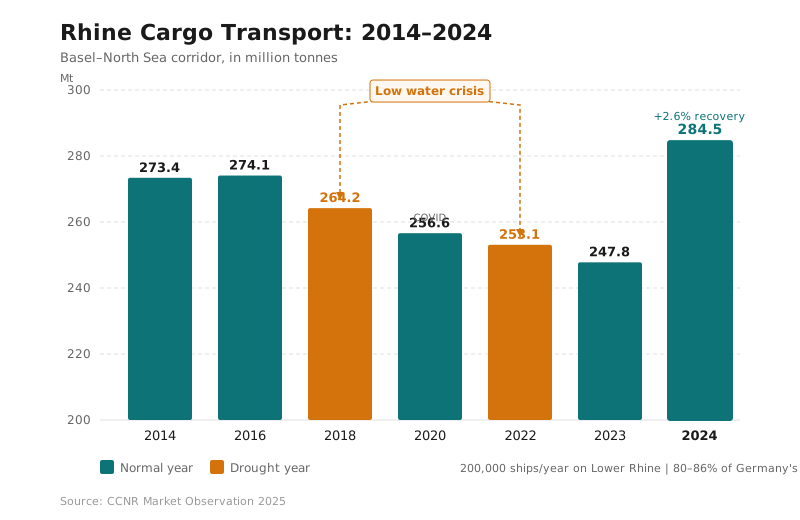
Despite its advantages, Rhine cargo transport faces headwinds. Low water events, which are increasing in frequency due to climate change, can force barges to reduce their loads by 30–50%, effectively doubling transport costs overnight. The 2018 and 2022 low-water crises demonstrated how quickly disruptions on the Rhine ripple through the entire European supply chain.
The energy transition is another structural factor. As Germany phases out coal-fired power generation, one of the Rhine’s largest cargo flows is shrinking. Between 2017 and 2023, coal shipments on the Rhine declined by approximately 20% (Source: Destatis, 2024). The temporary reversal in 2022 — when coal demand spiked due to the energy crisis — was an exception, not a trend reversal. The industry is banking on growth in container transport, hydrogen carriers, and new industrial feedstocks to compensate for the long-term decline in coal volumes.
I find it remarkable that despite these pressures, total Rhine freight volumes have remained broadly stable around 280–290 million tonnes for the past decade. The river’s competitive advantages — cost, capacity, and emissions efficiency — are simply too strong for shippers to abandon. For the broader context of Rhine shipping infrastructure, see our Rhine shipping overview.