Rhine Low Water Crisis 2018: When Dropping Water Levels Halted Shipping and Cost Germany 0.4% GDP
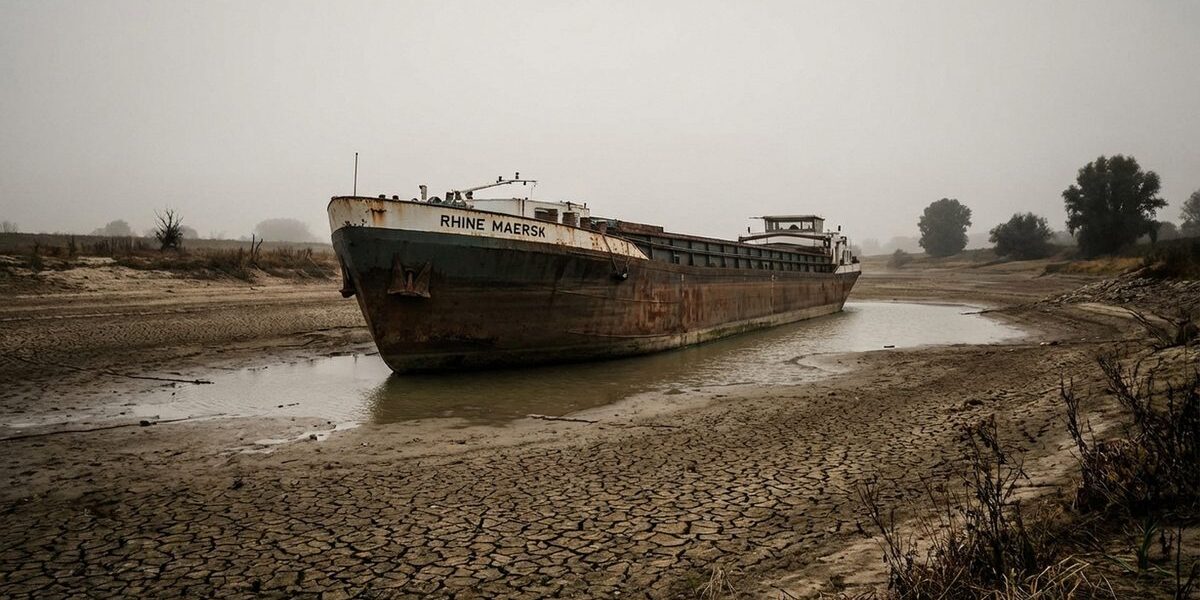
On October 22, 2018, the water gauge at Kaub — a narrow point on the Middle Rhine between Koblenz and Wiesbaden that serves as the critical bottleneck for inland navigation — recorded a water level of just 25 centimetres. That reading was not the depth of the river itself (the actual fairway depth was approximately 1.2 metres at that point), but it was so far below normal that most standard Rhine cargo barges could only load to 20–30% of their capacity. Some stretches became impassable entirely. For weeks, the Rhine — Europe’s economic lifeline — was functionally broken (Source: WSV, 2019).
Understanding Rhine Water Levels: The Kaub Gauge
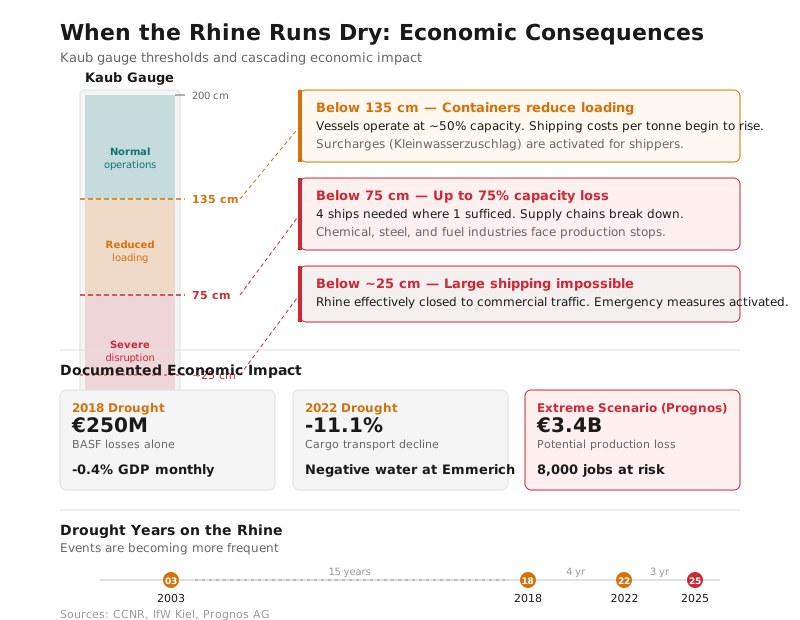
To understand the low-water crisis, you need to understand how Rhine water levels are measured. The Kaub gauge (Pegel Kaub, Rhine-km 546) is the most closely watched reference point for Rhine shipping. It does not measure absolute water depth, but rather the water level relative to a fixed zero point that was set historically. This means a gauge reading of zero does not mean the river is dry — at Kaub, a gauge reading of 0 cm still corresponds to a fairway depth of approximately 95 centimetres. The key thresholds are:
| Gauge Reading (cm) | Equivalent Fairway Depth (approx.) | Impact on Shipping |
|---|---|---|
| >200 | >2.9 m | Normal operations; full loading possible |
| 150 | ~2.4 m | Minor load reductions for deep-draft vessels |
| 78 | ~1.7 m | Significant load reductions (40–50% capacity); low-water surcharges apply |
| 40 | ~1.3 m | Only shallow-draft vessels operable; most barges at 20–30% capacity |
| <30 | <1.2 m | Near-cessation of commercial shipping; emergency conditions |
(Source: WSV, 2024; BfG, 2024)
The critical threshold is 78 cm at Kaub. Below this level, low-water surcharges (Kleinwasserzuschläge) kick in, and transport costs escalate sharply as barges must reduce their loads to avoid grounding. The surcharges can increase freight rates by 100–300% above normal levels, and in extreme cases, spot rates on the Rhine have spiked by 500% or more (Source: CCNR, 2024).
The 2018 Crisis: A Watershed Moment
The summer and autumn of 2018 brought the worst low-water event in modern Rhine history. A prolonged heatwave and drought across Central Europe — one of the driest periods recorded since systematic measurements began in the 19th century — slashed river discharge to levels not seen since 1947. At Kaub, the gauge remained below 78 cm for over 130 consecutive days between July and December. It hit a record low of 25 cm on October 22 (Source: BfG, 2019).
The consequences cascaded through the economy with remarkable speed. Chemical companies including BASF, Evonik, and Lanxess were forced to reduce production because raw materials could not be delivered by barge. BASF alone estimated its production losses at approximately 250 million euros for the year (Source: BASF Annual Report, 2019). Fuel prices at petrol stations in southern Germany and Switzerland spiked by 10–20 cents per litre as petroleum deliveries from Rotterdam slowed to a trickle. Grain exports were disrupted, hitting farmers already suffering from drought-damaged harvests. Steel production in the Ruhr was curtailed as iron ore deliveries faltered.
The Deutsche Bundesbank estimated that the Rhine shipping disruption reduced Germany’s GDP growth by approximately 0.2 percentage points in the third quarter of 2018 — a remarkable figure for a single transport route (Source: Deutsche Bundesbank, 2019). Industrial production in the Rhine corridor fell by 1.5% year-on-year during the worst months. The crisis made national headlines and, for the first time, brought the vulnerability of Rhine shipping to public attention far beyond the logistics industry.
2022: History Repeats
Just four years later, the Rhine ran dry again. In August 2022, the Kaub gauge dropped below 30 cm, once more crippling shipping. This time, the crisis hit against the backdrop of the energy crisis triggered by Russia’s invasion of Ukraine. Coal shipments to power plants — urgently needed as Germany scrambled to replace Russian gas with coal-fired electricity generation — were severely disrupted at exactly the moment they were most needed. Low-water surcharges pushed transport costs to five or six times the normal rate (Source: CCNR, 2023).
The 2022 event was shorter than 2018 — the Kaub gauge recovered to workable levels by late September — but its timing during an energy emergency amplified its impact. The German government was forced to consider emergency rail capacity for coal deliveries that normally travel by barge, highlighting the fragility of single-mode logistics dependencies.
Together, the 2018 and 2022 crises confirmed what hydrologists had been warning for years: low water on the Rhine is no longer a rare anomaly. It is a recurring structural risk that demands systemic adaptation.
Climate Change: The Underlying Driver
The Rhine’s hydrology is changing. The river is fed by a combination of Alpine snowmelt, rainfall, and groundwater. Climate change is altering all three sources. Glaciers in the Swiss Alps — which provide critical baseflow during summer when rainfall is scarce — have lost over 30% of their volume since 2000 and are projected to lose 50–80% by 2100 (Source: GLAMOS, 2024). The Aletsch Glacier alone, the largest in the Alps and a significant contributor to Rhine headwaters, has retreated by over 3 kilometres since 1850.
Summer rainfall in the Rhine basin is becoming more erratic, with longer dry spells punctuated by intense but brief storms that cause flooding rather than replenishing groundwater. Groundwater levels in the Upper Rhine Graben have declined in recent decades, reducing the baseflow that sustains the river during dry periods (Source: ICPR, 2024).
Climate projections suggest that low-water events comparable to 2018 could occur every 5–10 years by mid-century, compared with every 20–30 years historically (Source: BfG, 2023). For the 285 million tonnes of cargo that depend on the Rhine, this is a systemic threat. For more on how climate change is reshaping the Rhine, see our article on climate change and the Rhine ecosystem.
Adaptation Strategies
Governments and the shipping industry are responding with a range of adaptation measures, though none alone can fully compensate for declining water availability:
Shallow-draft vessels. New barge designs with reduced draft can carry meaningful loads even when water levels are critically low. Prototype vessels with a maximum draft of 1.2 metres (compared to 2.5–3.0 metres for conventional barges) are being tested on the Rhine. However, these vessels sacrifice capacity during normal water conditions, creating an economic trade-off that has slowed adoption. The ideal solution may be a fleet that mixes shallow-draft and standard vessels, deploying each type according to conditions (Source: CCNR, 2024).
Improved forecasting. The German Federal Institute of Hydrology (BfG) has extended its reliable water-level forecasting from 4 days to 10 days using enhanced hydrological models and satellite data. Longer lead times allow shippers to adjust loading plans and reroute cargo to rail or road before conditions become critical. A 14-day forecast is the target for the next generation of models (Source: BfG, 2024).
Fairway deepening. The German federal government has committed to deepening the fairway at critical bottlenecks on the Middle Rhine, including the Kaub narrows and several shoals near St. Goar. The goal is to gain 20–30 centimetres of additional fairway depth, which would significantly extend the navigability window during low water. However, environmental concerns — including impacts on aquatic habitats and the UNESCO World Heritage landscape — have slowed progress. As a biologist, I understand both sides of this debate: the economic case for deepening is strong, but the ecological costs of altering riverbed morphology in one of Europe’s most ecologically sensitive river stretches must be carefully assessed.
Multimodal flexibility. Companies that previously relied solely on Rhine barges are investing in multimodal logistics — maintaining rail and road backup capacity that can absorb cargo when the river becomes impassable. BASF, for example, has invested in dedicated rail connections at Ludwigshafen and pre-negotiated emergency trucking contracts. The cost of this redundancy is significant, but the 2018 and 2022 crises demonstrated that the cost of unpreparedness is higher (Source: BDB, 2024).
Water management and storage. Longer-term proposals include using existing reservoirs in the Rhine basin more strategically to release water during dry periods, though the volumes needed to meaningfully raise Rhine levels are enormous. The ICPR is coordinating a basin-wide study on water storage potential (Source: ICPR, 2024).
For the broader physical context of the Rhine’s river sections and geography, including the narrow Middle Rhine valley where low water bites hardest, see our geography section.
What Lies Ahead
The Rhine low-water crisis is not a single event but a slow-motion structural shift. The river that carries Europe’s freight is becoming less reliable at exactly the moment when climate-driven demand for resilient infrastructure is growing. The Rhine shipping industry will survive — the economics are too compelling for it not to — but the era of taking the river’s navigability for granted is over. Every degree of warming, every lost glacier, every dry summer brings the next crisis closer. The question is not whether the Rhine will run low again, but whether Europe will be ready when it does.