Fish of the Rhine: 71 Species, the Salmon’s Return & the State of Rhine Biodiversity
In 1985, a team of fisheries biologists surveyed a stretch of the Lower Rhine near Düsseldorf and found almost nothing. A handful of pollution-tolerant species — roach, bream, a few eels — survived in water that carried more industrial chemicals than dissolved oxygen. The Rhine, once one of Europe’s most productive salmon fisheries, had been reduced to an ecological wasteland.
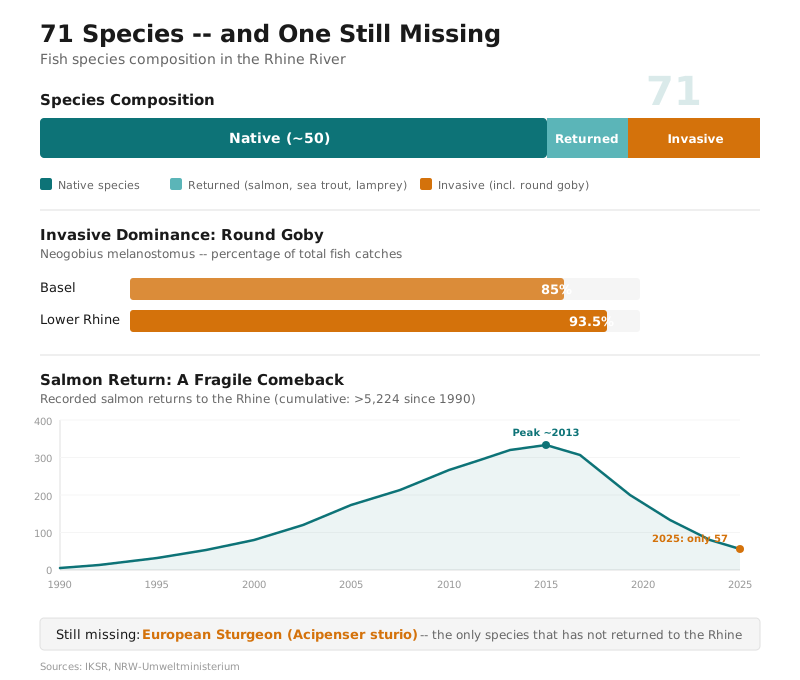
Today, the International Commission for the Protection of the Rhine (ICPR) records 71 fish species — including cyclostomata such as river and sea lamprey — across the Rhine system (Source: ICPR, 2023). That number tells a story of recovery, investment, and biological resilience. But it does not tell the whole story. Behind the headline figure lie critical questions about which species are thriving, which are merely surviving, and which face new threats that did not exist when the cleanup began.
Key Fish Species of the Rhine
The Rhine’s fish community spans a wide range of ecological niches, from cold-water specialists in Alpine tributaries to warm-water generalists in the Lower Rhine floodplains. The following table summarises some of the most ecologically and economically significant species, including their current status:
| Species | Scientific Name | Status | Habitat | Notes |
|---|---|---|---|---|
| Atlantic Salmon | Salmo salar | Reintroduced (stocking-dependent) | Cold, fast-flowing tributaries | Flagship species; 350–800 spawning adults estimated (2024) |
| Sea Trout | Salmo trutta trutta | Recovering | Tributaries, migratory | Returns to Sieg and Agger for spawning |
| European Eel | Anguilla anguilla | Critically Endangered (IUCN) | Entire river, catadromous | 150,000 killed in 1986 Sandoz disaster; continent-wide decline |
| River Lamprey | Lampetra fluviatilis | Present | Lower Rhine, tributaries | Cyclostome; indicator of good water quality |
| Sea Lamprey | Petromyzon marinus | Rare | Migratory, lower sections | Requires unobstructed passage to spawning grounds |
| Common Barbel | Barbus barbus | Stable | Middle Rhine, gravel beds | Characteristic of the “barbel zone” in flowing rivers |
| Asp | Leuciscus aspius | Recovering | Main channel, open water | Predatory cyprinid; benefits from improved water clarity |
| Pike-Perch (Zander) | Sander lucioperca | Common | Slower sections, harbours | Commercially important; tolerates moderate turbidity |
| Nase | Chondrostoma nasus | Declining | Middle Rhine, gravel substrates | Sensitive to habitat loss; needs intact spawning gravel |
| Common Bream | Abramis brama | Common | Lower Rhine, slow-flowing | Abundant in the “bream zone” of the Lower Rhine |
| Round Goby | Neogobius melanostomus | Invasive — dominant | Stony substrates, entire Rhine | Over 93% of catches in Lower Rhine; arrived 2008 |
| Grayling | Thymallus thymallus | Declining | Upper Rhine, cold tributaries | Threatened by rising water temperatures |
| Bullhead | Cottus gobio | Present (under pressure) | Tributaries, stony substrates | EU Habitats Directive Annex II; displaced by round goby |
| Wels Catfish | Silurus glanis | Expanding | Deep pools, Lower Rhine | Europe’s largest freshwater fish; benefits from warming |
The Salmon: Symbol of Recovery — and Its Limits
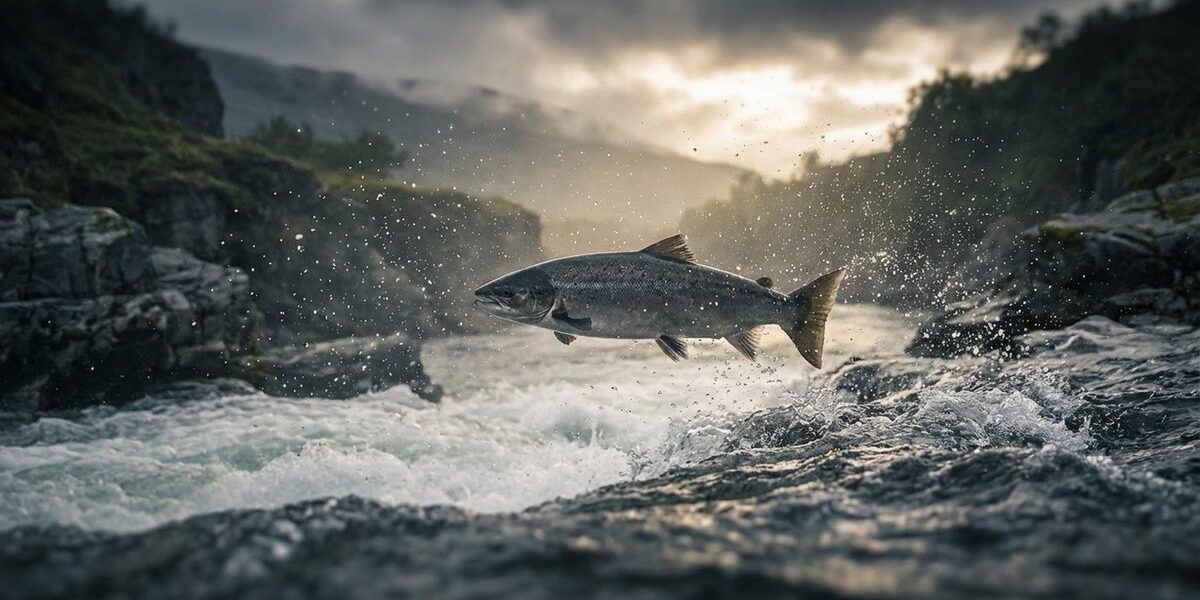
No species better represents the Rhine’s ecological trajectory than the Atlantic salmon. Historical records from Basel describe salmon runs so abundant that domestic servants reportedly negotiated contract clauses limiting how often they could be served salmon for dinner. Professional salmon fisheries operated along the entire Rhine from the Dutch delta to Basel. By the 1950s, the species had vanished entirely — blocked by dams, poisoned by pollutants, and deprived of spawning habitat by river channelisation.
The Rhine Action Programme of 1987 adopted the salmon as its flagship species. The logic was elegant: if salmon could complete their entire life cycle in the Rhine — migrating from the North Sea through the main channel to tributary spawning grounds, reproducing successfully, and having juveniles migrate back to the sea — it would prove the river was ecologically functional at every scale, from water chemistry to habitat connectivity.
Stocking began in 1988, with the first juvenile salmon released into the River Sieg, a tributary of the Lower Rhine near Bonn. The programme expanded rapidly: from 1995 onwards, more than 500,000 salmon fry were released annually into Rhine tributaries including the Sieg, Agger, Saynbach, and several tributaries in France and Luxembourg (Source: ICPR, 2016). Simultaneously, fish passes were constructed or improved: by 2023, upstream salmon migration was possible at approximately 480 obstacles across the Rhine system (Source: ICPR, 2023).
“In 2015, 228 salmon were counted at the Iffezheim fish pass on the Upper Rhine — the highest number since the reintroduction programme began.” — Source: ICPR, 2016
Yet the salmon story also carries a sobering warning. A 2024 study published in River Research and Applications found that the Rhine salmon population has actually declined over the past two decades, despite continued stocking. The estimated spawning population stands at just 350–800 individuals. The return rate of stocked smolts — young salmon migrating to sea — is only 0.5–0.6%, far below the approximately 3% needed for a self-sustaining population (Source: Rijssel et al., River Research and Applications, 2024).
The reasons are multiple. The ten hydropower barrages between Iffezheim and Basel still lack effective fish passage — salmon can reach Iffezheim but struggle to go further upstream. Mortality during downstream migration through turbines remains high. Water temperatures in some tributaries are rising above the thermal tolerance of salmon eggs and fry. And predation by cormorants and wels catfish takes an additional toll on returning adults.
In practical terms, Rhine salmon remain entirely dependent on hatcheries. Remove the stocking programme, and the population would likely collapse within a few generations. The salmon’s “return” is real — adults are present, spawning occurs — but self-sustaining reproduction has not been achieved.
Winners and Losers in the New Rhine
The 71-species figure, while impressive, masks significant shifts in community composition. Some species have thrived in the recovering Rhine. Others face new pressures that did not exist during the river’s most polluted decades.
Winners: Warm-water generalists like pike-perch, wels catfish, and common bream have benefited from improved water quality and — paradoxically — from rising water temperatures that expand their preferred thermal range. Invasive species like the round goby have exploited the improved conditions, the artificial stone habitats lining the Rhine’s navigable stretches, and the Rhine-Main-Danube Canal corridor to establish dominant populations throughout the system.
Losers: Cold-water specialists like grayling and brown trout face mounting pressure from rising water temperatures. The grayling, which requires sustained periods below approximately 18°C, is already declining in the Upper Rhine and lower-altitude tributaries. Rheophilic species (those preferring fast, well-oxygenated currents) such as the nase continue to decline due to habitat degradation — channelisation has eliminated the shallow gravel riffles they need for spawning, and dams disrupt the flow variability they depend on.
The European eel, devastated by Sandoz in 1986, remains critically endangered — not primarily because of Rhine-specific conditions, but due to a continent-wide recruitment collapse. Eel larvae (leptocephali) that cross the Atlantic Ocean from the Sargasso Sea are arriving in European waters in dramatically reduced numbers, a decline likely driven by oceanic changes, parasitic infection by the introduced nematode Anguillicola crassus, and historical overfishing of juveniles (glass eels). The Rhine’s improved water quality helps surviving eels, but cannot address the species’ oceanic crisis.
Habitat: The Unfinished Business
Water quality improvements alone cannot restore a complete fish community. Physical habitat — the structure of the riverbed, the connectivity of floodplains, the availability of spawning substrates, and the natural flow variability — matters just as much. In many stretches, the Rhine remains a heavily engineered navigation channel: straightened, deepened, and armoured with stone embankments (rip-rap) that provide poor habitat for most native species but excellent habitat for invasive round gobies.
The ICPR’s Rhine 2040 strategy prioritises habitat restoration alongside continued water quality work. Ongoing projects include reconnecting former side channels and oxbow lakes along the Upper and Lower Rhine, creating fish-friendly bank structures, and restoring gravel beds in tributaries to support spawning of barbel, nase, and trout. These efforts are essential: without functional habitat, improved water quality produces a clean river with a diminished fish community.
Looking Ahead
The path forward requires addressing three simultaneous challenges: maintaining the hard-won water quality gains that enabled recovery, restoring the physical habitat that supports reproduction and recruitment, and adapting to a warming river that will increasingly favour warm-water generalists over the cold-water specialists that define a healthy Central European river ecosystem.
Seventy-one species is a number to celebrate — but only if we keep asking what each of those species needs to remain in the Rhine for the long term.