Rhine Water Quality: How 9 Countries Invested 80 Billion Euros to Revive a Dying River
In 1971, the Dutch city of Rotterdam had a problem. The water arriving through its taps — drawn from the Rhine — tasted of chemicals and sometimes smelled of phenol. Fish pulled from the river near the Ruhr were unfit to eat. Heavy metals accumulated in floodplain soils. The Rhine, shared by nine countries, was delivering industrial waste from six of them directly to the drinking water supply of 20 million people.
Fifty years and more than 80 billion euros later, the Rhine serves as a global model for transboundary water quality management. In 2013, it received the European Riverprize for “remarkable achievements in integrated river basin management following a 50-year legacy of river degradation” (Source: ICPDR, 2013). But the victory over legacy pollutants has revealed an entirely new class of contaminants that conventional treatment plants were never designed to catch.
From Open Sewer to Drinking Water Source
The Rhine’s water quality crisis had been building since the 19th century, but it reached its nadir in the 1960s and 1970s. Dissolved oxygen in the Lower Rhine regularly fell below the 3 mg/L threshold required by most fish species — and sometimes approached zero. The river was biologically dead along significant stretches, particularly through the Ruhr industrial corridor between Cologne and Duisburg, where steel works, chemical plants, and coal mines concentrated their effluent.
Ammonia concentrations were so high that they were directly toxic to fish. Phosphorus from untreated municipal sewage fuelled massive algal blooms. Heavy metals — mercury from chlor-alkali plants, cadmium from zinc smelters, chromium from leather tanneries — accumulated in sediments and entered the food chain. In the Netherlands, farmers were advised not to use Rhine floodwater for irrigation.
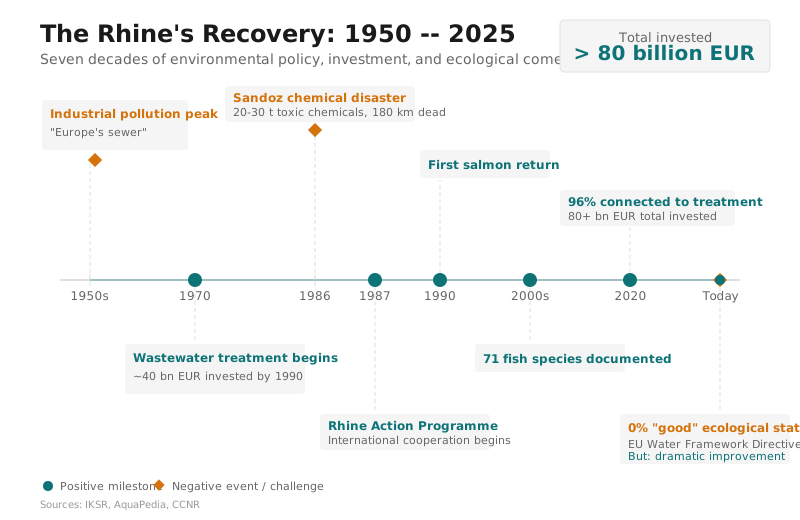
The turning points came in two waves. First, the establishment of international water quality conventions in the 1970s forced the first generation of wastewater treatment investments. The 1976 Rhine Chemical Convention set discharge limits for specific substances. Second, the Sandoz disaster of November 1, 1986 — when 20 tonnes of toxic pesticides washed into the Rhine from a warehouse fire near Basel, killing 150,000 eels and hundreds of thousands of other fish — shocked Europe into the Rhine Action Programme (RAP).
The RAP, launched by the International Commission for the Protection of the Rhine (ICPR) in 1987, set concrete targets: halve the discharge of 44 priority substances by 2000, restore the Rhine as a safe drinking water source, enable the return of migratory fish species including the Atlantic salmon, and reduce the risk of industrial accidents.
The Investment: Where 80 Billion Euros Went
The scale of infrastructure investment was unprecedented for a river system. Across the nine Rhine basin states — Switzerland, Austria, Liechtenstein, Germany, France, Luxembourg, Belgium, the Netherlands, and Italy (a small portion of the basin extends into Italy via the Ticino) — governments and industries built or upgraded thousands of wastewater treatment plants. The headline numbers tell the story:
- 96% of the Rhine catchment population is now connected to municipal wastewater treatment plants — up from approximately 60% in the early 1970s (Source: ICPR, 2020)
- Heavy metal discharges (mercury, cadmium, lead, chromium, copper, zinc) dropped by 70–100% between 1985 and 2000
- Phosphorus loads fell by more than 50%, dramatically reducing eutrophication and the algal blooms that had plagued the Lower Rhine and Dutch waterways
- Chloride concentrations — once so high from Alsatian potash mining that they threatened Dutch agriculture and corroded water infrastructure — declined sharply after France progressively closed the mines
- Biological oxygen demand (BOD), a key indicator of organic pollution, dropped to levels not seen since the pre-industrial era in some stretches
The investment was not distributed evenly. Germany bore the largest share, with the Ruhr region requiring massive upgrades to handle effluent from steel, chemical, and manufacturing plants. The Emscher river system — once an open sewer running through the heart of the Ruhr — received its own multi-billion-euro restoration programme. Switzerland invested heavily in upstream treatment, reducing the pollutant load entering Germany at Basel. The Netherlands, as the downstream recipient of everything upriver, pushed hardest for binding international standards.
“The success of the Rhine cleanup lies in the polluter-pays principle applied across borders. Upstream nations invested in treatment because downstream nations demanded clean water — and international law backed them up.” — Source: AquaPedia, Water Quality and Pollution Control in the Rhine River Basin
Measuring Success: What the Data Shows
By the mid-1990s, the ecological indicators were moving decisively in the right direction. Dissolved oxygen levels stabilised above 8 mg/L across most of the Rhine — sufficient for sensitive species including salmonids. Ammonia concentrations dropped to non-toxic levels. The water became visibly clearer.
The most dramatic improvement was in the Middle and Lower Rhine. Stretches that had been devoid of aquatic life in the 1970s saw the return of mayfly larvae (Ephemeroptera), caddisfly (Trichoptera), and other pollution-sensitive macroinvertebrates — species that serve as reliable biological indicators of water quality. Their return confirmed that the chemical improvements were translating into genuine ecological recovery.
Fish species counts rose steadily. By 2000, 63 species were recorded. By 2023, that number reached 71 species, including the returning Atlantic salmon and sea trout. The river that Rotterdam once refused to drink from was again a functioning ecosystem — and once again supplying drinking water to millions, with treatment of course, but treatment that no longer had to cope with extreme contamination.
The New Pollutants: 60+ Substances Above Target
Despite the enormous investment, the Rhine’s water quality story is not one of unqualified success. A 2022 assessment by RIWA-Rijn, the association of Dutch Rhine water companies, found that more than 60 substances exceeded target values (Source: RIWA-Rijn, 2023). The most problematic categories include:
- Pharmaceutical residues — 25 substances detected above target levels, including painkillers (diclofenac, ibuprofen), antibiotics, hormones, and X-ray contrast media (iopamidol, iomeprol) that pass through patients and into municipal wastewater
- Industrial chemicals — 14 substances including PFAS (per- and polyfluoroalkyl substances), the so-called “forever chemicals” used in non-stick coatings, fire-fighting foam, and waterproof textiles
- Pesticides — trace amounts of agricultural chemicals entering via tributaries and groundwater, particularly from intensive farming regions in the Netherlands and northwest Germany
- Microplastics — 191 million particles per day reaching the North Sea, with peak concentrations in the Rhine-Ruhr area
These micropollutants represent a fundamentally different challenge than the heavy metals and gross organic pollution of the 20th century. They are present in very low concentrations — often measured in nanograms per litre — but can be biologically active. Endocrine disruptors, for example, can affect fish reproduction at concentrations far below conventional detection limits. Pharmaceutical residues can promote antibiotic resistance in aquatic bacteria. PFAS persist indefinitely in the environment and bioaccumulate in organisms and humans.
Conventional wastewater treatment plants, the backbone of the 80-billion-euro investment, were designed to remove suspended solids, organic matter, nitrogen, and phosphorus. They were not engineered to intercept nanogram-level pharmaceutical residues or synthetic chemicals that are specifically designed to be stable. Upgrading to advanced treatment — ozonation, activated carbon filtration, or membrane filtration — is technically proven but requires significant additional investment. Estimates suggest billions more euros across the basin to retrofit existing plants.
Rhine 2040: The Next Chapter
The ICPR’s Rhine 2040 programme, adopted in 2020, acknowledges this new reality. It targets a 30% reduction in discharges of pharmaceuticals, X-ray contrast agents, and pesticides by 2040. It also calls for a source-control approach — reducing pollutants before they enter the water cycle rather than trying to filter them out at treatment plants. This means engaging with the pharmaceutical industry, agriculture, and consumer products manufacturing.
Switzerland has led the way, mandating advanced treatment (ozonation or activated carbon) at its largest wastewater treatment plants since 2016 — a programme expected to cost approximately 1.2 billion Swiss francs. Germany is debating similar requirements at the federal level. The Netherlands continues to advocate for stricter EU-wide standards, pointing out that as the downstream nation, it inherits every pollutant that upstream countries fail to intercept.
New EU drinking water regulations, effective from 2026, set legally binding limit values for PFAS — adding regulatory pressure. The EU Water Framework Directive’s objective of “good ecological and chemical status” for all European water bodies has not yet been achieved for the Rhine, and the deadline has been extended to 2027.
The 80 billion euros already spent bought a transformation from biological death to a functioning river ecosystem. The next phase will cost less in raw euros but demand more in scientific precision, industrial innovation, and political coordination across borders. The Rhine’s water quality journey proves that rivers can be cleaned — and that cleaning them is a task that never truly ends.
Sources & References
- ICPR: Rhine Water Quality — Current Status
- German Environment Agency: Sandoz Chemical Spill — The Turning Point
- ICPR: Drinking Water from the Rhine