Rhine Shipping: 285 Million Tonnes on Europe’s Busiest Inland Waterway
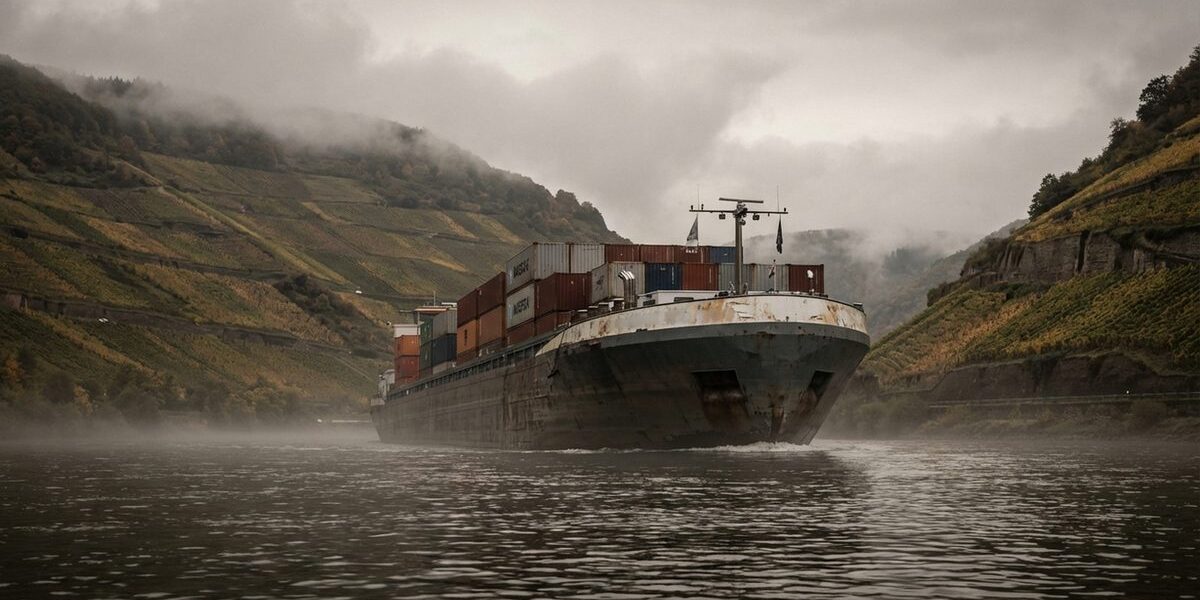
Stand on any bridge over the Lower Rhine near Duisburg, and you will count a barge passing roughly every seven minutes. Day and night, 365 days a year, the river moves cargo between the North Sea port of Rotterdam and industrial hubs as far south as Basel, Switzerland. With an annual freight volume of approximately 285 million tonnes, the Rhine is not just Europe’s busiest inland waterway — it is the continent’s most important logistics corridor after the open seas (Source: CCNR, 2024).
I have spent years studying the Rhine’s ecology, but the sheer industrial scale of its shipping traffic never stops impressing me. This page serves as your guide to Rhine shipping — from the legal framework that keeps it free, to the cargo types filling those barges, to the economic forces that make every centimetre of water depth a headline.
A Brief History: From Medieval Tolls to Free Navigation
For centuries, Rhine shipping was strangled by tolls. In the Middle Ages, over 60 toll stations lined the river between Mainz and Cologne. Each feudal lord, bishop, or city demanded payment — a system so burdensome that merchants sometimes chose overland routes despite the higher cost. The Congress of Vienna in 1815 established the Central Commission for the Navigation of the Rhine (CCNR), the world’s oldest international organisation still in operation. But the real breakthrough came with the Mannheim Act of 1868 (Revised Rhine Navigation Act), which established two principles that remain in force today: freedom of navigation for vessels of all nations, and the prohibition of tolls based solely on the act of navigating the river (Source: CCNR, 2023).
These principles transformed the Rhine into a free-trade highway long before the European Union existed. Today, the Mannheim Act still governs Rhine navigation, and the CCNR — headquartered in Strasbourg — continues to set technical standards, safety regulations, and crew qualifications for the entire Rhine fleet. The commission brings together representatives from Switzerland, France, Germany, Belgium, and the Netherlands, making it one of the oldest examples of successful multinational governance in the world.
The 19th century also saw dramatic physical improvements to the river itself. The engineer Johann Gottfried Tulla straightened the Upper Rhine between Basel and Mannheim in the early 1800s, eliminating hundreds of meanders and cutting the navigable distance by nearly 80 kilometres. Later, the construction of groynes (stone jetties) along the Lower and Middle Rhine concentrated the current, deepening the fairway and enabling larger vessels to navigate year-round. These engineering works, combined with the legal freedom established by the Mannheim Act, created the conditions for the Rhine to become Europe’s premier freight corridor.
The Rhine Shipping Corridor: Key Numbers
| Metric | Value | Source |
|---|---|---|
| Annual freight volume | ~285 million tonnes | CCNR, 2024 |
| Navigable length (North Sea to Basel) | ~883 km | WSV, 2024 |
| Vessel movements per year (Niederrhein) | >200,000 | WSV, 2024 |
| Share of EU inland waterway transport | ~67% | Eurostat, 2024 |
| Active fleet (Rhine-registered vessels) | ~7,500 cargo vessels | CCNR, 2024 |
| Container throughput | ~2.3 million TEU | CCNR, 2024 |
| Major ports served | 8+ (Rotterdam to Basel) | CCNR, 2024 |
| Countries connected | 6 (CH, FR, DE, LU, NL, BE via canals) | CCNR, 2024 |
| Governing body | CCNR (est. 1815) | CCNR, 2023 |
What the Rhine Carries: Cargo Types and Volumes
The Rhine is not a one-commodity river. Its cargo portfolio is remarkably diverse, reflecting the industrial structure of Western Europe. The largest single category is dry bulk — iron ore, coal, building materials, and grain — which accounts for roughly 45% of total tonnage. Liquid bulk (petroleum products, chemicals, liquefied gases) makes up about 30%, while containerised cargo has grown steadily over the past two decades and now represents around 15% of freight by volume and a much higher share by value (Source: CCNR, 2024).
A single large Rhine barge with a capacity of 3,000 tonnes replaces approximately 150 truck journeys or 60 rail wagons. When barges are coupled into push convoys on the Lower Rhine, a single unit can carry up to 12,000 tonnes — the equivalent of 480 trucks removed from the already congested A1 and A3 motorways (Source: BDB, 2024). For more detail on cargo types and their economic significance, see our dedicated article on Rhine cargo transport.
The Modal Split: Rhine vs. Road vs. Rail
In the Rhine corridor between Rotterdam and the German-Swiss border, inland waterway transport captures a modal share of approximately 40% of all freight by tonne-kilometres, compared with roughly 38% for road and 22% for rail (Source: Eurostat, 2023). This is exceptional. In most European freight corridors, road transport dominates with shares above 70%. The Rhine’s high modal share for waterway transport is a direct result of its navigability, the density of industrial facilities along its banks, and the cost advantage of barge transport — which is 30–50% cheaper per tonne-kilometre than trucking (Source: BDB, 2024).
The environmental argument strengthens the economic one. A Rhine barge emits approximately 16 grams of CO2 per tonne-kilometre, compared with roughly 22 grams for rail and 62 grams for a heavy goods vehicle (Source: CE Delft, 2023). Shifting just 10% of the Rhine corridor’s road freight to barges would eliminate an estimated 1.5 million tonnes of CO2 emissions annually — a fact that European transport policymakers increasingly recognise in their modal shift strategies.
The Fleet: From Family Barges to Corporate Push Convoys
The Rhine fleet is a mix of old and new. At one end, family-operated motor vessels of 1,000–2,500 tonnes capacity still ply the river, often with the skipper’s home built into the stern accommodation. These owner-operators — many of them Dutch or German families who have been in the trade for generations — form the backbone of the fleet by number, even as their share of total tonnage declines. At the other end, modern push convoys operated by large logistics companies like HGK Shipping, Imperial Logistics, or Rhenus can push four or six lighters at once, moving over 10,000 tonnes in a single trip. The fleet also includes approximately 1,500 tanker vessels for liquid cargo, plus a growing number of container barges that shuttle standardised boxes between Rotterdam and inland terminals at Duisburg, Cologne, Mannheim, and Basel (Source: CCNR, 2024).
A significant challenge facing the fleet is its age. The average Rhine cargo vessel is over 40 years old, and the industry is under pressure from the EU and CCNR to transition toward low-emission propulsion — including LNG, hydrogen fuel cells, and battery-electric drives. Several pilot projects are already underway: the hydrogen-powered vessel H2 Barge 1 began trials on the Rhine in 2024, and Rhenus has ordered a series of electric-hybrid container barges for the Rotterdam–Duisburg corridor. But full fleet renewal will take decades and billions of euros in investment (Source: CCNR, 2024).
Safety and Regulation on the Rhine
Navigating the Rhine is governed by a comprehensive regulatory framework. The Rhine Police Regulations (Rheinschifffahrtspolizeiverordnung) set rules for vessel traffic, speed limits, passing procedures, and behaviour at locks and bridges. Crew members must hold CCNR-standardised certificates, and vessel operators must comply with technical inspection regimes covering hull integrity, engine emissions, and safety equipment (Source: CCNR, 2024).
River Information Services (RIS) — a network of radar, AIS (Automatic Identification System) transponders, electronic chart displays, and real-time water-level data — have dramatically improved safety and efficiency since their introduction in the early 2000s. Today, every commercial vessel on the Rhine transmits its position, speed, and cargo status in real time, enabling traffic management centres at critical points like Duisburg, Oberwesel, and Basel to coordinate vessel movements and prevent accidents. The Rhine’s accident rate has fallen steadily as a result, though collisions and groundings still occur, particularly during fog or high water (Source: WSV, 2024).
Economic Significance: Why the Rhine Matters to GDP
The Rhine shipping corridor directly supports an estimated 200,000 jobs in navigation, port operations, logistics, and shipbuilding (Source: CCNR, 2024). The goods transported — from crude oil and chemicals feeding the BASF complex at Ludwigshafen (the world’s largest integrated chemical site) to coal and iron ore supplying the steelworks of the Ruhr — underpin manufacturing output worth hundreds of billions of euros annually.
When low water disrupted Rhine shipping in 2018, Germany’s industrial production dropped measurably, and the Bundesbank estimated the disruption shaved approximately 0.2 percentage points off Germany’s GDP growth in the third quarter of that year (Source: Deutsche Bundesbank, 2019). That single statistic illustrates the Rhine’s systemic importance: it is not merely a transport route, but a critical piece of European economic infrastructure. For a closer look at low-water impacts, see Low Water Crisis: When the Rhine Runs Dry.
The Major Ports: Hubs Along the Rhine
Eight major ports anchor the Rhine corridor. Rotterdam, at the river’s mouth, is Europe’s largest seaport and the primary gateway connecting Rhine barges to global ocean shipping. Duisburg, 230 kilometres upstream, operates the world’s largest inland port by throughput — its container terminal alone handles over 4 million TEU per year. Further south, Cologne, Mannheim/Ludwigshafen, Karlsruhe, Kehl/Strasbourg, and Basel serve as critical nodes for their respective industrial regions. Each port has its own specialisation — chemicals at Ludwigshafen, containers at Duisburg, grain at Strasbourg, petroleum at Karlsruhe. Explore the full port network in our guide to the major ports on the Rhine.
Passenger Shipping: River Cruises and Ferries
The Rhine is not all cargo. The river cruise industry has boomed since the early 2000s, and the stretch between Koblenz and Rüdesheim — the UNESCO World Heritage Upper Middle Rhine Valley — is one of the most popular river cruise routes in the world. An estimated 500,000 passengers per year cruise the Rhine on purpose-built longships operated by companies like Viking, AmaWaterways, and A-Rosa (Source: IG RiverCruise, 2024). Ferry services also remain important for local transport at dozens of crossing points where no bridge exists — the Rhine between Mainz and Koblenz, for example, has no fixed bridge at all, making ferries essential for communities on opposite banks. Learn more in our article on Rhine river cruises.
Challenges and the Future of Rhine Shipping
Rhine shipping faces a convergence of challenges that will define its trajectory over the coming decades. Climate change is increasing the frequency of low-water events, as the drought summers of 2018 and 2022 demonstrated with devastating clarity. Adaptation strategies — including shallower-draft vessel designs, improved water-level forecasting, and sediment management — are being developed but require significant coordination among the six Rhine states (Source: ICPR, 2024). For a deeper understanding of the Rhine’s physical geography, see our geography section.
Decarbonisation is the second major challenge. The European Green Deal and national climate targets demand a near-complete phase-out of fossil fuels in inland navigation by 2050. The CCNR’s roadmap envisions a transition through LNG as a bridge fuel, followed by hydrogen and electric propulsion. However, the infrastructure for alternative fuels — bunkering stations, charging facilities, hydrogen refuelling points — barely exists along the Rhine today. The investment needed to build this infrastructure is estimated at several billion euros over the next two decades (Source: CCNR, 2024).
Digitalisation is a brighter story. The Rhine is becoming a testbed for autonomous navigation, with pilot projects for remotely operated barges already underway in the Netherlands. River Information Services (RIS), including real-time AIS tracking and electronic chart displays, are now standard, and the CCNR is working on harmonised data standards to enable corridor-wide traffic management. The Dutch company Seafar has been operating remotely navigated barges on Belgian waterways since 2022 and plans to extend operations to the Rhine (Source: CCNR, 2024).
The ecological dimension also matters. Shipping contributes to underwater noise, wave erosion of banks, and the risk of fuel or cargo spills. The wash from large vessels can damage reed beds and fish spawning habitats along the river’s margins. Balancing the Rhine’s role as an economic lifeline with its function as an ecosystem — home to over 60 fish species and thousands of invertebrate taxa — is an ongoing challenge explored in our ecology section.
Explore Rhine Shipping
This pillar page provides the overview. Dive deeper into the topics that matter most:
- Rhine Cargo Transport: 285 Million Tons Per Year — cargo types, volumes, and the economics of barge freight
- Major Ports on the Rhine: Rotterdam, Duisburg, Basel — port profiles, throughput data, and specialisations
- Low Water Crisis: When the Rhine Runs Dry — drought impacts, the Kaub gauge, and adaptation strategies
- Rhine River Cruises: Exploring the River by Boat — routes, operators, and the passenger shipping industry
Sources & References
- Central Commission for Navigation of the Rhine (CCNR): Rhine Shipping Statistics 2024
- CCNR: Rhine Fleet — 6,900 Vessels
- GDWS: Rhine Navigation — 884 km